WHO'S NRML?
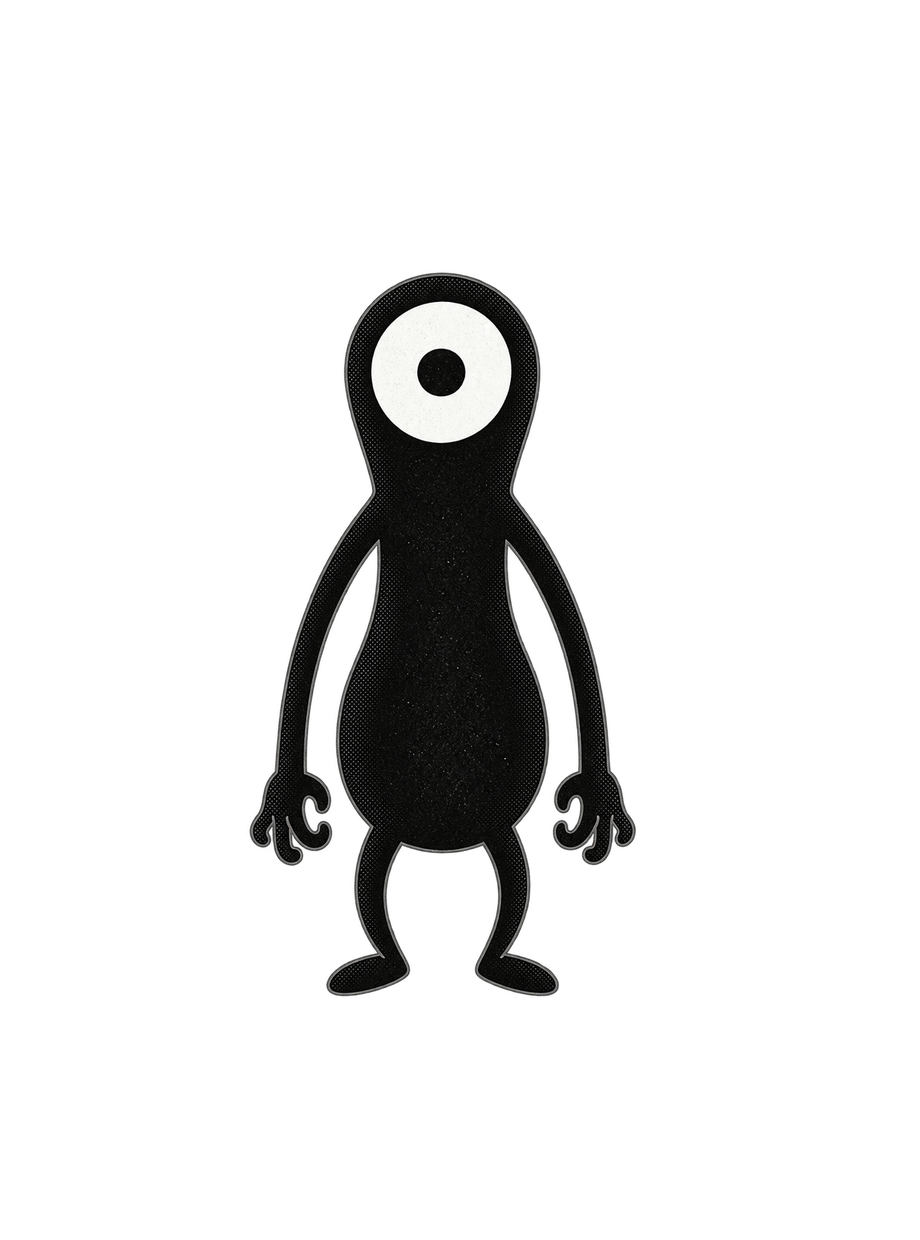
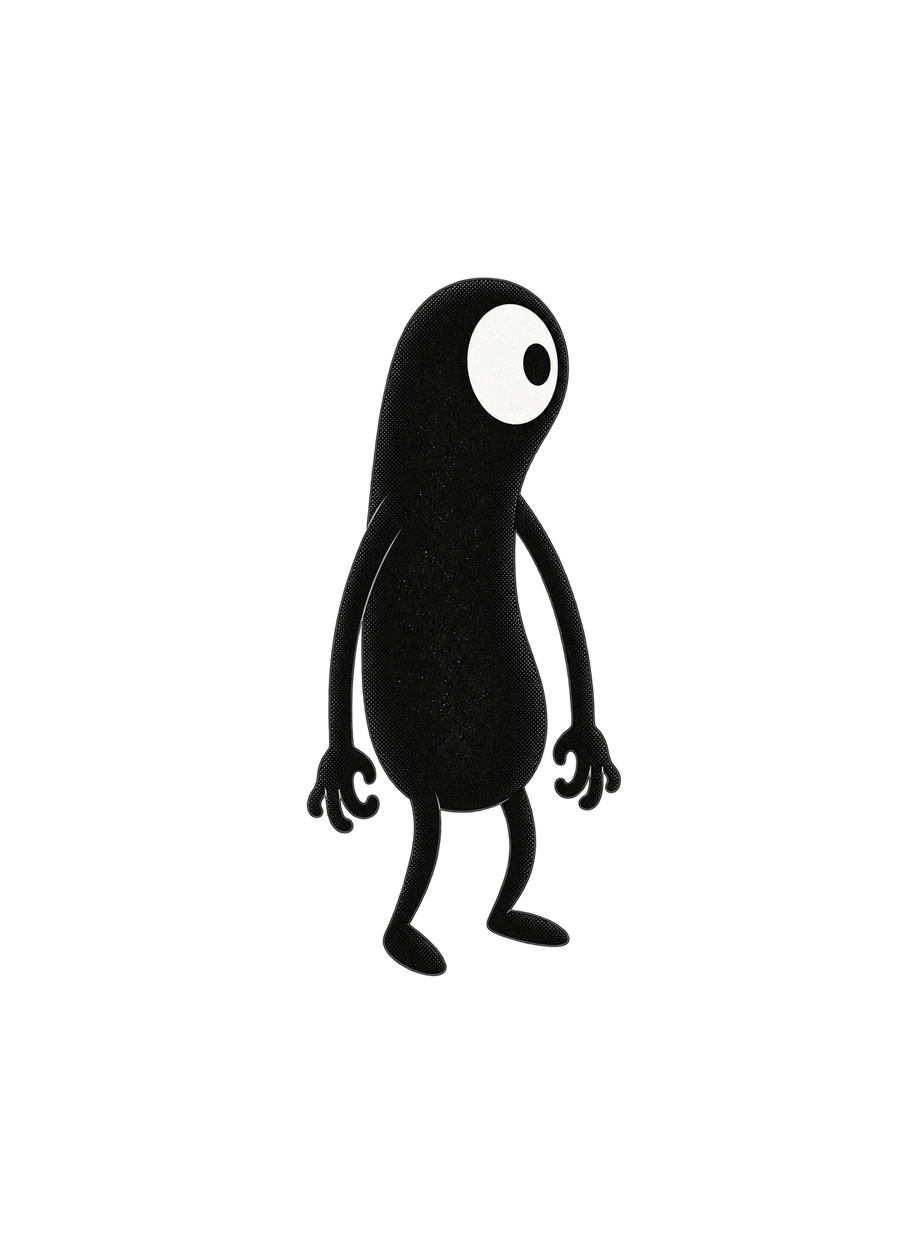
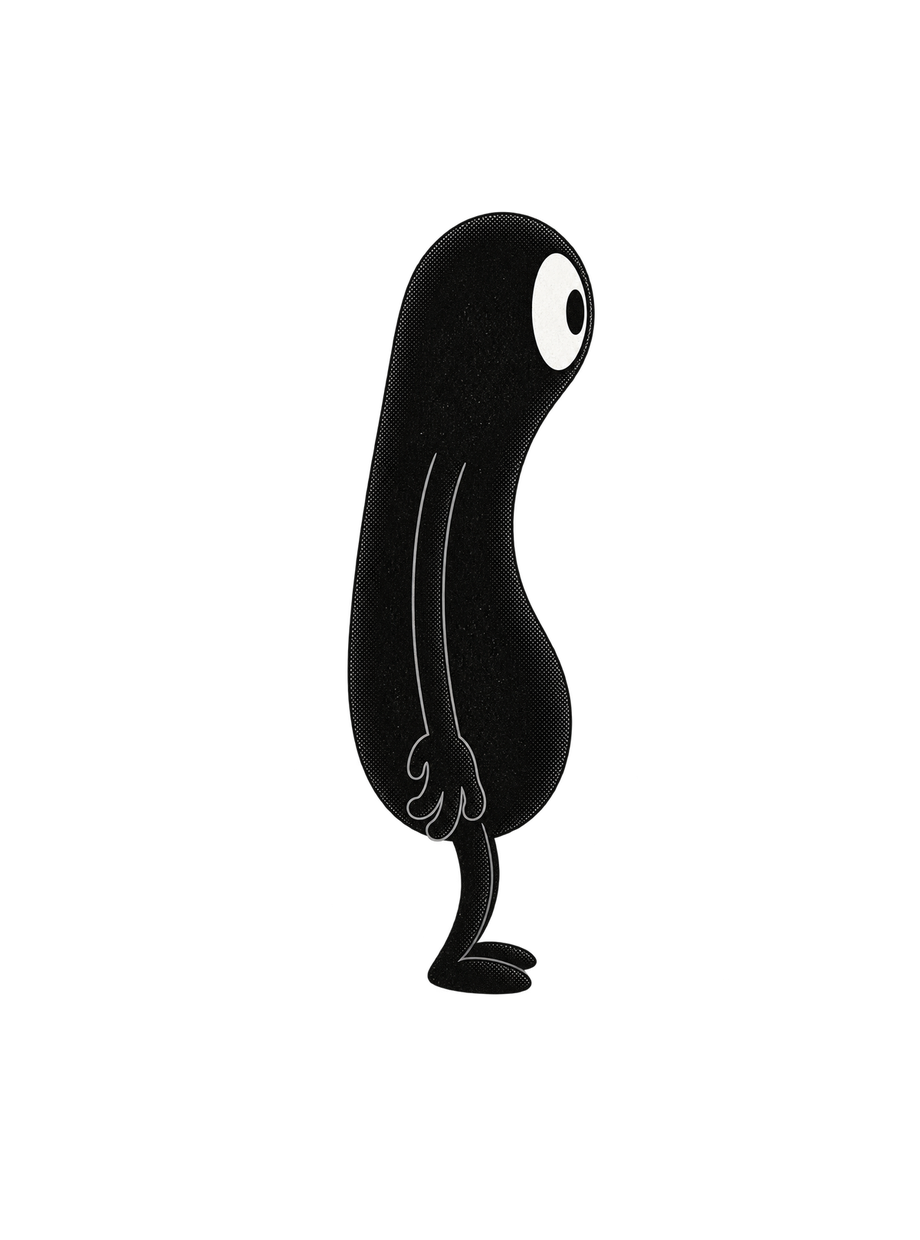
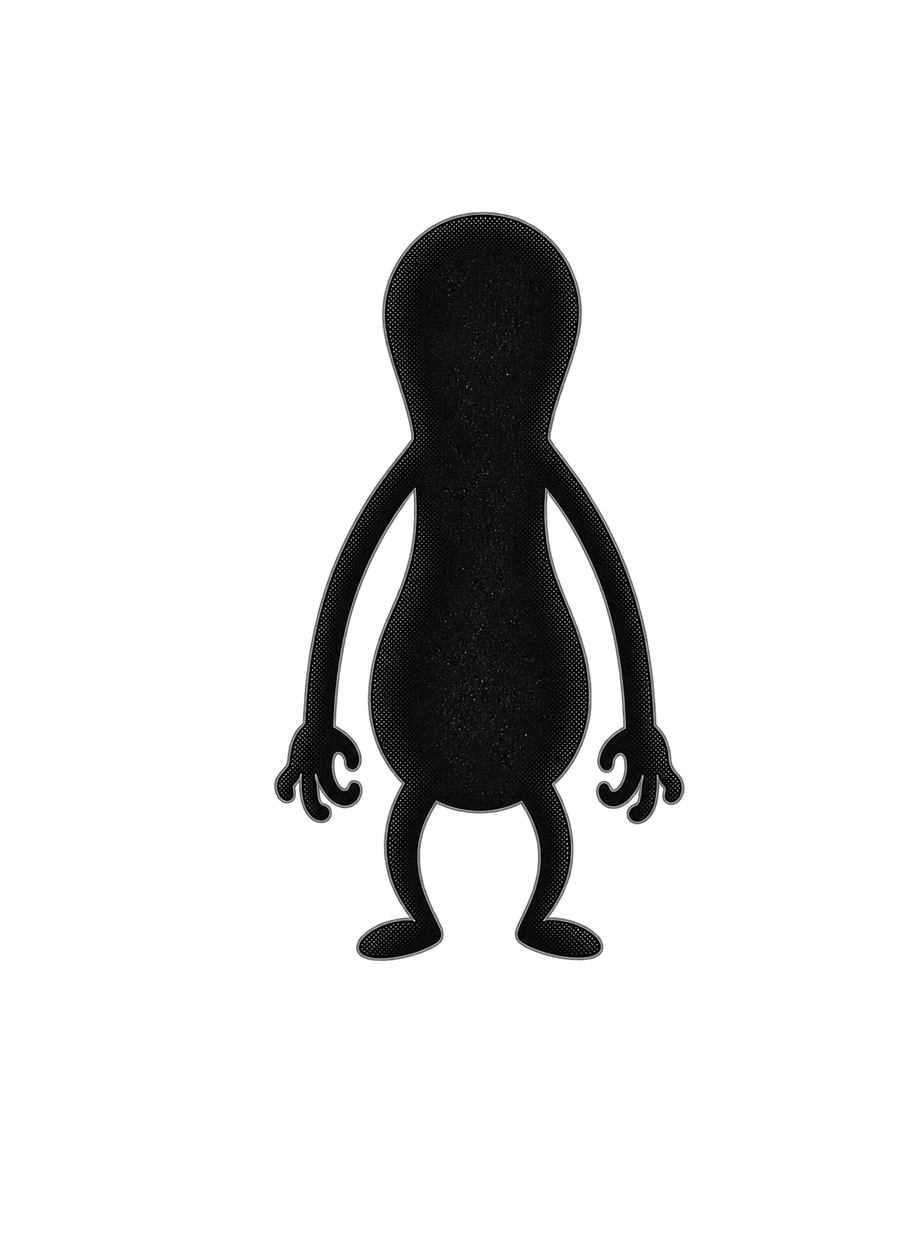
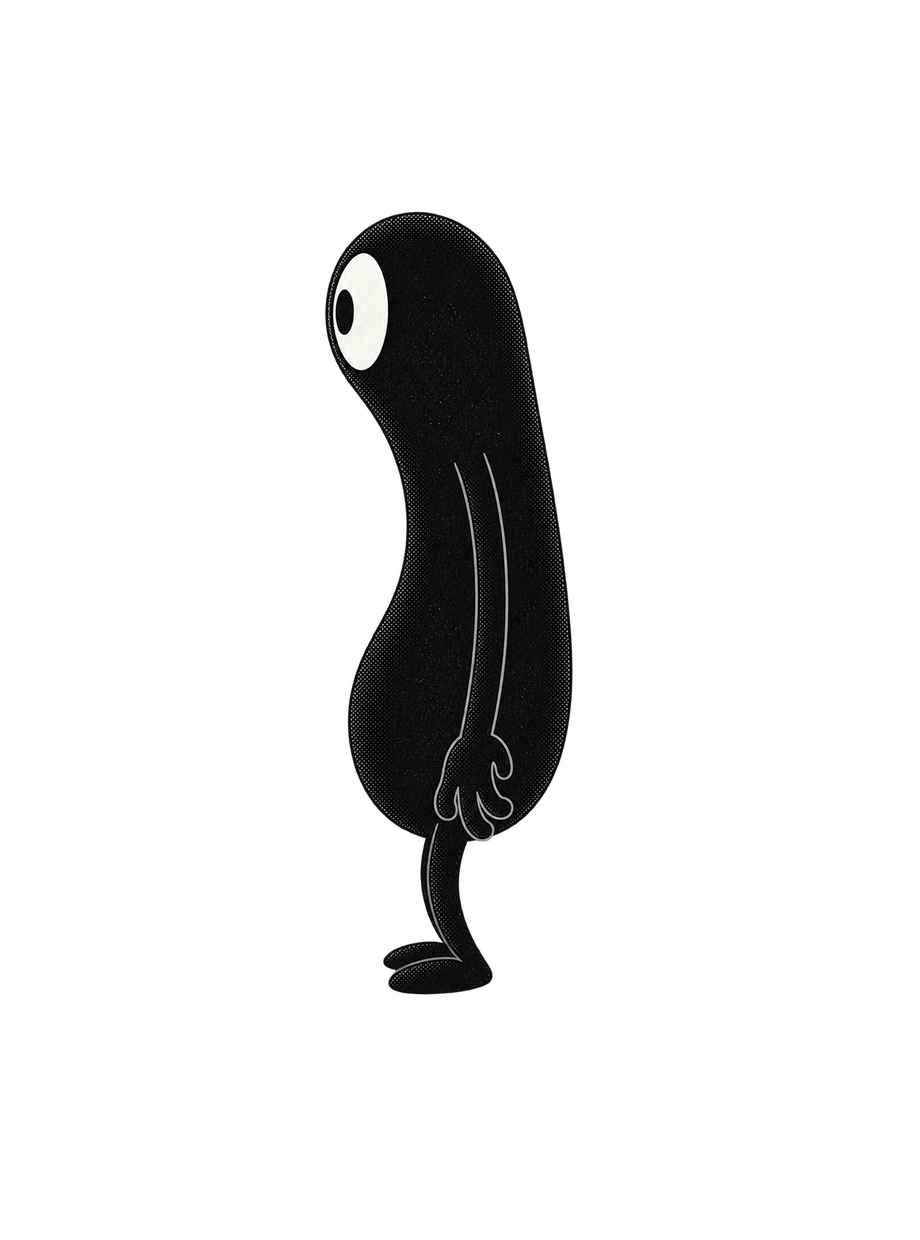
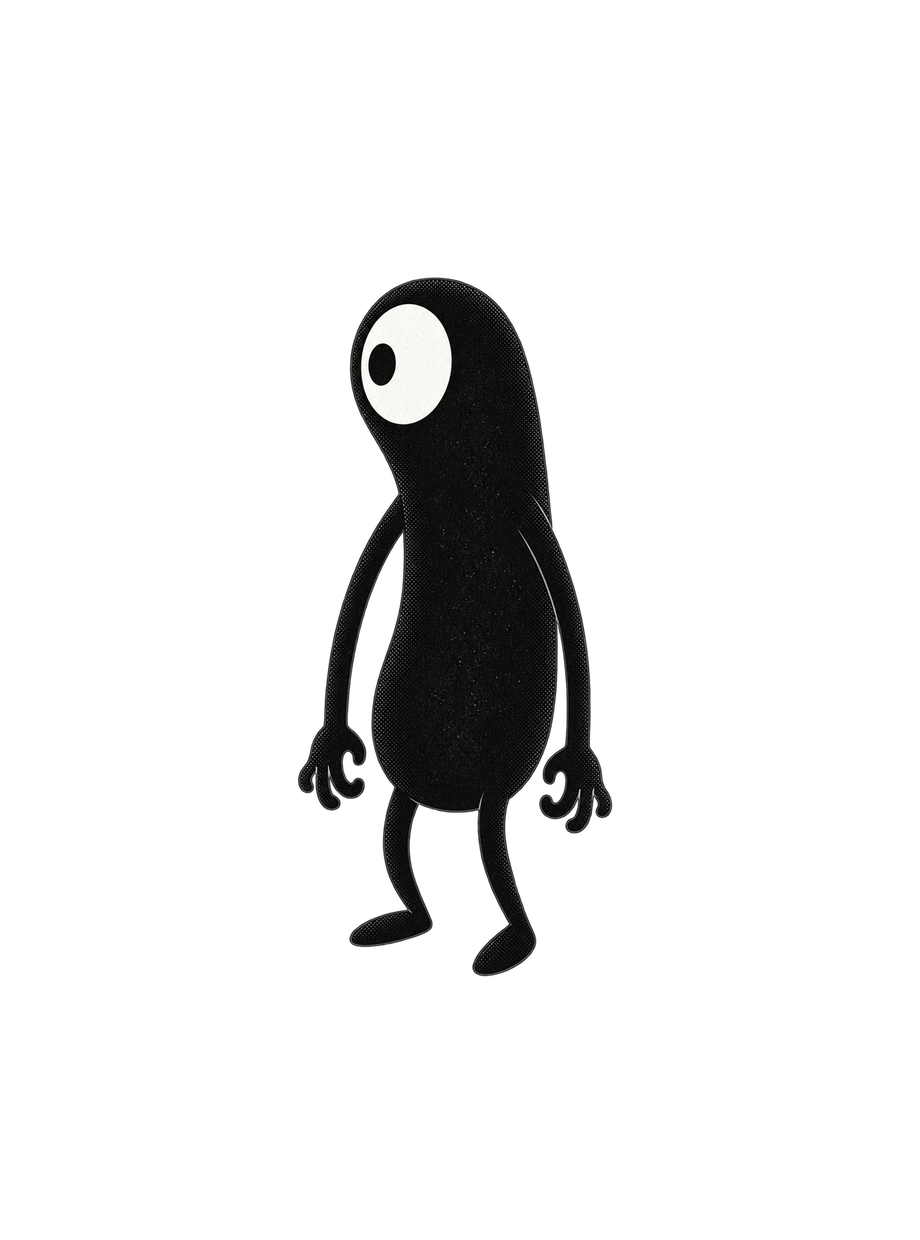
- 01 / SHELL
- The black body
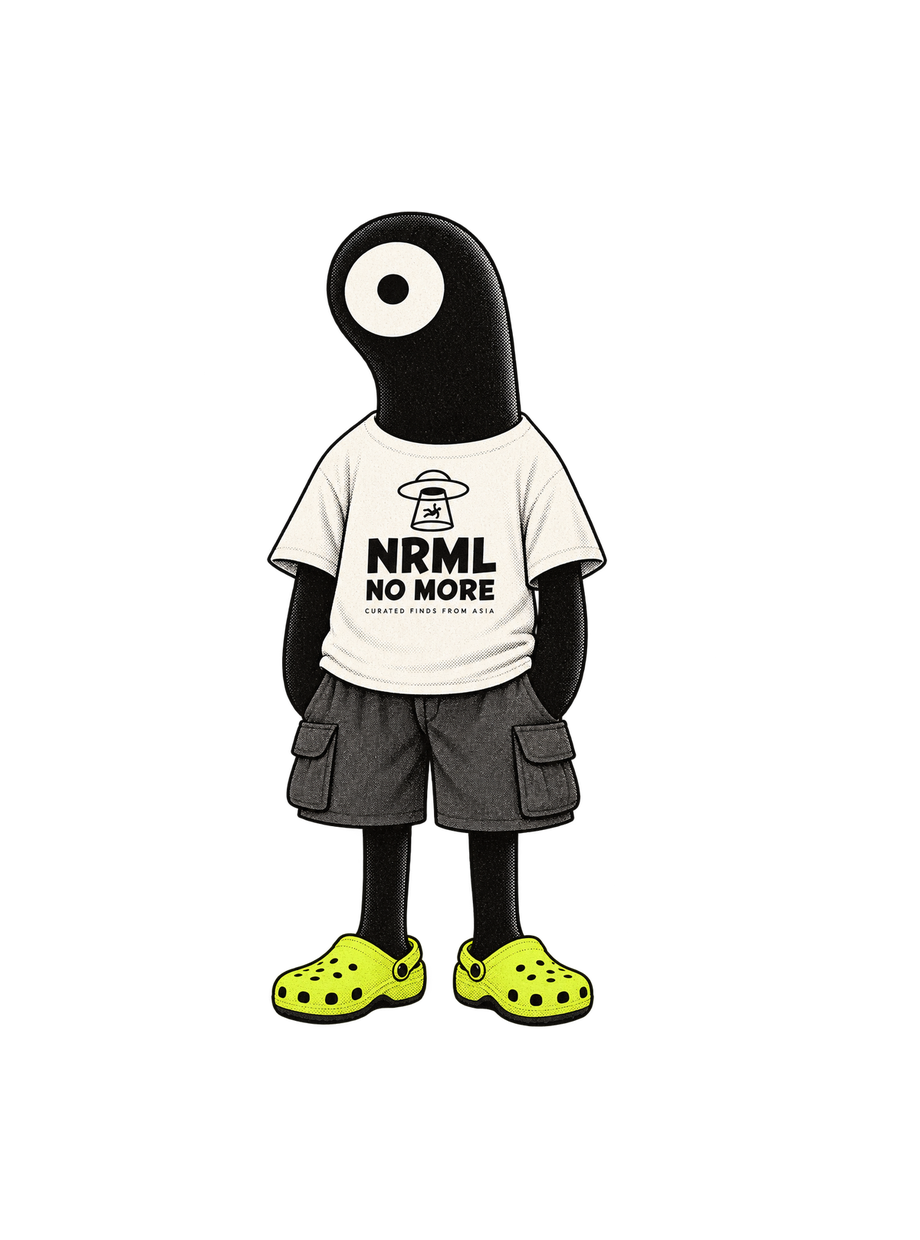
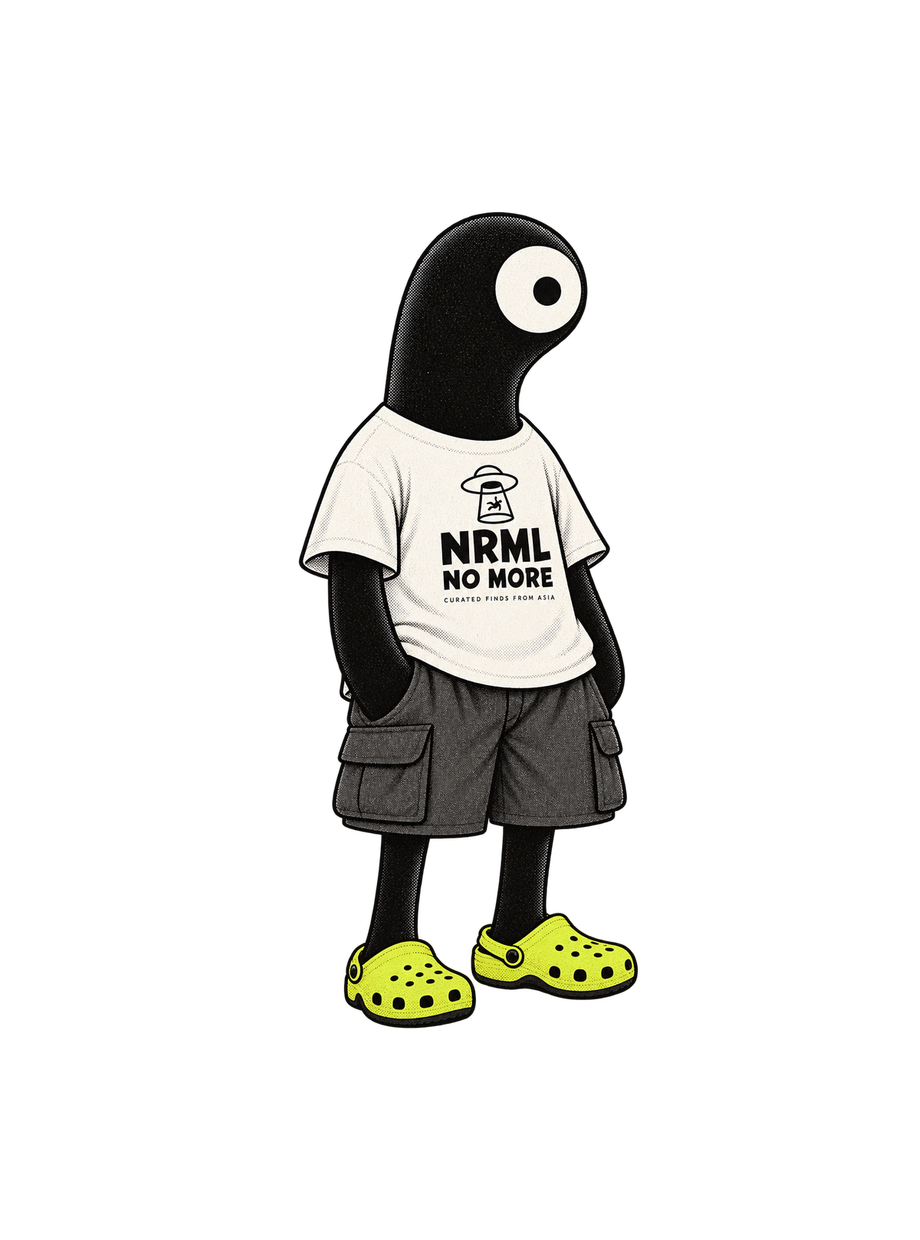
- 02 / EARTH
- The Earth shell version
- 03 / SELF
- The Preference Kernel
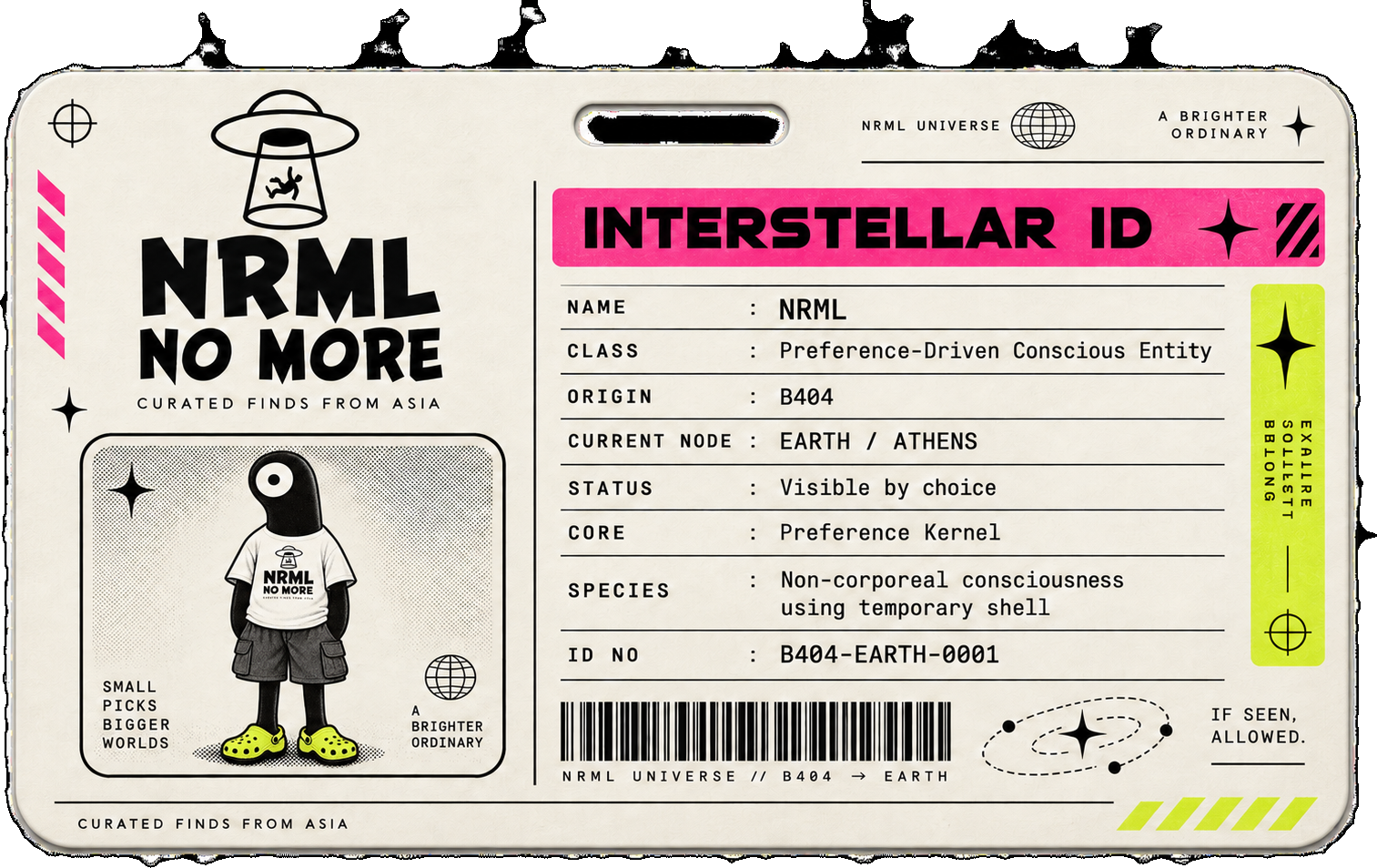
NRML is a post-biological conscious entity from B404. His body is, strictly speaking, just an interface. His Preference is who he is. His Earth friends like to call him a “five-dimensional creature,” which NRML finds adorable, considering humans still have plenty to argue about in three.
One of his earliest official Earth interactions ended—depending on whom you ask—in an abduction. NRML’s incident report calls it “a short-range spatial evacuation carried out in response to a verbal request.” It happened somewhere in Asia. A person having a terrible day said, almost in passing, “I seriously need to escape.” NRML had learned the language.
He had not yet learned metaphor.
So he took the human away in his spacecraft.
Five Earth seconds later, the human began explaining figures of speech, context, consent, and kidnapping. NRML accepted the first three concepts reasonably well. He still disputes the accuracy of the fourth—mostly on his own.
That incident later became the NRML NO MORE symbol.
NRML’s explanation is much simpler:
“They just decided to leave normal. Like you, who found us and are reading this right now.”
Where’s B404?
NRML comes from B404, although B404 is neither its real name nor technically a planet. “B404” was simply the identifier he entered when an Earth database insisted that every place needed one. He later discovered “404 Not Found” and found it funny enough not to correct the record.
B404 is an ancient ring civilisation built around an artificially stabilised stellar core. Humans put solar panels on rooftops. B404, a very long time ago, effectively plugged an entire civilisation directly into a star and moved on.
Energy stopped being scarce. Matter became reconfigurable. Bodies became editable. Disease became mostly maintenance. Memory could be stored externally, knowledge downloaded, senses redesigned and stable wormholes engineered.
READ THE FULL CHAPTER
A Creature could theoretically exist until the surrounding astronomical structure itself stopped cooperating. B404 therefore has no meaningful equivalent of rent, wages or “basic living security.” Telling a Creature that food and housing are guaranteed would be roughly like congratulating a human because oxygen remains available (positive, certainly; not much of a lifestyle benefit).
Solving almost everything created a stranger problem.
If you can replace your body, copy knowledge, store memory and redesign most of yourself, what is left that is actually you?
B404 found one answer it could study but never truly install: a Preference Kernel.
NRML uses the shorter Earth word:
taste.
Give two Creatures the same body, knowledge and abilities, then show them the same universe. One looks left. The other looks right.
That difference matters.
On B404, what Earth might call a “hobby” can last several million years. Some Creatures study the exact moment one state becomes another. Some watch diamond rain, not because diamonds are valuable (humans made that part weird), but because disorder suddenly becoming structure never stops being interesting. Others follow the final photons of dead civilisations or rebuild their senses simply to find out whether rain still feels like rain in another body.
These persistent questions form Affinity Rings.
NRML never fitted into one.
His interests looked messy. He could study an unfinished civilisation for a century, then become distracted by its street markets, lucky colours, packaging, clothes, pointless ornaments or why somebody had decided to put a face on a spoon.
Eventually the pattern became obvious.
NRML was not interested in the correct answer.
He was interested in the moment when there wasn’t one.
When several answers work, why this one?
Why this cup? Why this colour? Why funny socks nobody can see? Why twenty-seven versions of a T-shirt when one already performs the important task of covering a torso? Why keep something for ten years after it stopped being useful?
B404 became better and better at correct answers.
NRML became interested in everything that refused to have one.
B404’s Problem
Being unclustered was not illegal, shameful or especially rebellious. B404 is far too old to care whether somebody’s interests look respectable.
The problem was time.
A Creature can exist for an extremely long time. Given enough centuries and enough information, attention can begin to flatten. Everything becomes equally interesting, which is a polite way of saying nothing feels worth a second look.
READ THE FULL CHAPTER
B404 calls this Cognitive Drift.
Its solution was Core Integration, and objectively, it was an excellent deal: stability, knowledge, safety, purpose, almost no downside.
There was only one detail NRML disliked.
The Core would help decide what deserved his attention.
Nobody was forcing him. That almost made it worse. The system had millions of years of evidence and was probably right.
NRML understood all of this.
He left anyway.
He did not escape an evil empire. He escaped a world that was usually correct about what was best for him.
B404 still checks in occasionally through an administrative entity NRML calls CLERK (this is not its real designation; CLERK has never acknowledged the nickname). CLERK remains politely concerned. NRML remains “busy.” Neither side has made much progress.
Why Earth?
By B404 standards, Earth is technologically underdeveloped. Humans still burn things for energy, physically move products across oceans, inhabit bodies with almost no replaceable parts and spend roughly one third of their lives unconscious, then wake up and complain that there is not enough time.
NRML was not impressed.
Then he noticed something strange.
READ THE FULL CHAPTER
Humans have limited time, limited money and limited storage space, yet continue producing enormous quantities of things nobody technically needs: funny socks, tiny charms, rings that do nothing, cards we shuffle before asking ourselves questions, T-shirts with unnecessary graphics, objects shaped like cats and boxes containing another box containing something we were not allowed to see before paying for it.
We even take one object, hide it inside more objects, decorate the outside and call the whole thing a gift.
NRML thought this was spectacular.
B404 had spent an enormous amount of time optimising unnecessary choices out of daily life.
Earth appeared to manufacture them recreationally.
NRML calls our current stage of civilisation The Messy Golden Interval. We are connected enough for objects, ideas and people to move everywhere, but not yet optimised enough for everywhere to feel the same. A centuries-old workshop can sit beside a global chain. A shop with a terrible website can contain something extraordinary. A teenager can reinterpret something a grandparent has made for fifty years and accidentally create a new aesthetic.
Earth is inefficient, fragile and badly organised.
Unfortunately, it is also extremely interesting.
Then NRML discovered recommendation algorithms.
“For You.” “Based on your activity.” “People like you also bought…”
He stared at the screen for approximately 11 Earth seconds.
“Oh,” he said. “You’re building another B404.”
NRML does not dislike recommendation systems. B404 built much better ones millions of Earth years ago.
That was exactly the problem.
When prediction becomes excellent, life gets easier. The recommendations improve. Irrelevant things disappear. You waste less attention.
And eventually, you also meet fewer things the system never expected you to like.
That is where NRML NO MORE really begins.
Not with socks.
Not with jewellery.
Not even with the idea of opening a shop.
With one question:
If everything becomes perfectly personalised, where does surprise go?
😂 WHY NRML LOOKS LIKE HE’S ABOUT TO STEAL SOMETHING?
NRML would like it formally noted that he does not look suspicious. He looks discreet.
On B404, unnecessarily occupying another Creature’s attention is considered impolite, so NRML naturally prefers edges, corners, half-open spatial folds and places human peripheral vision is bad at monitoring. Earth has somehow translated this behaviour into “probably about to steal something.” NRML considers that a cultural misunderstanding.
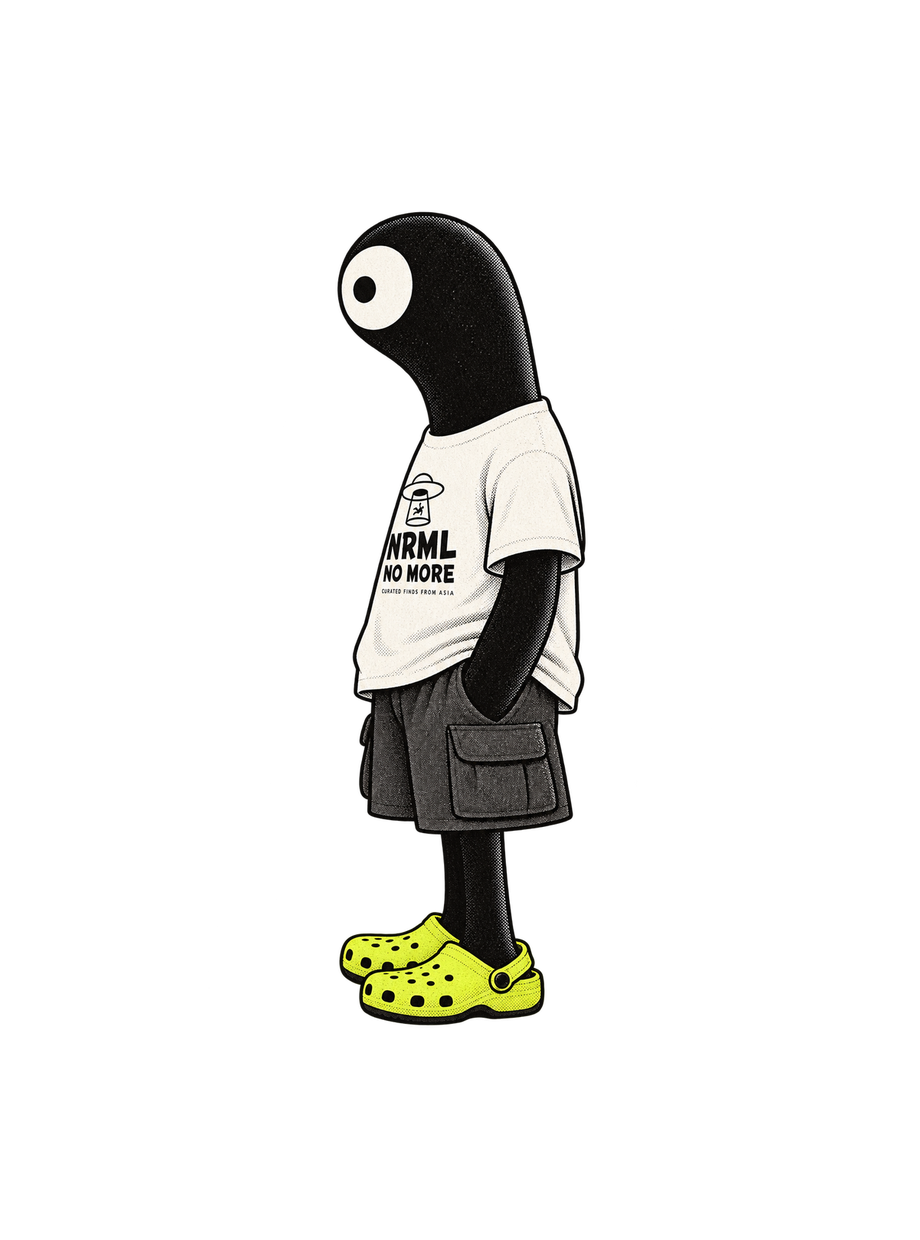
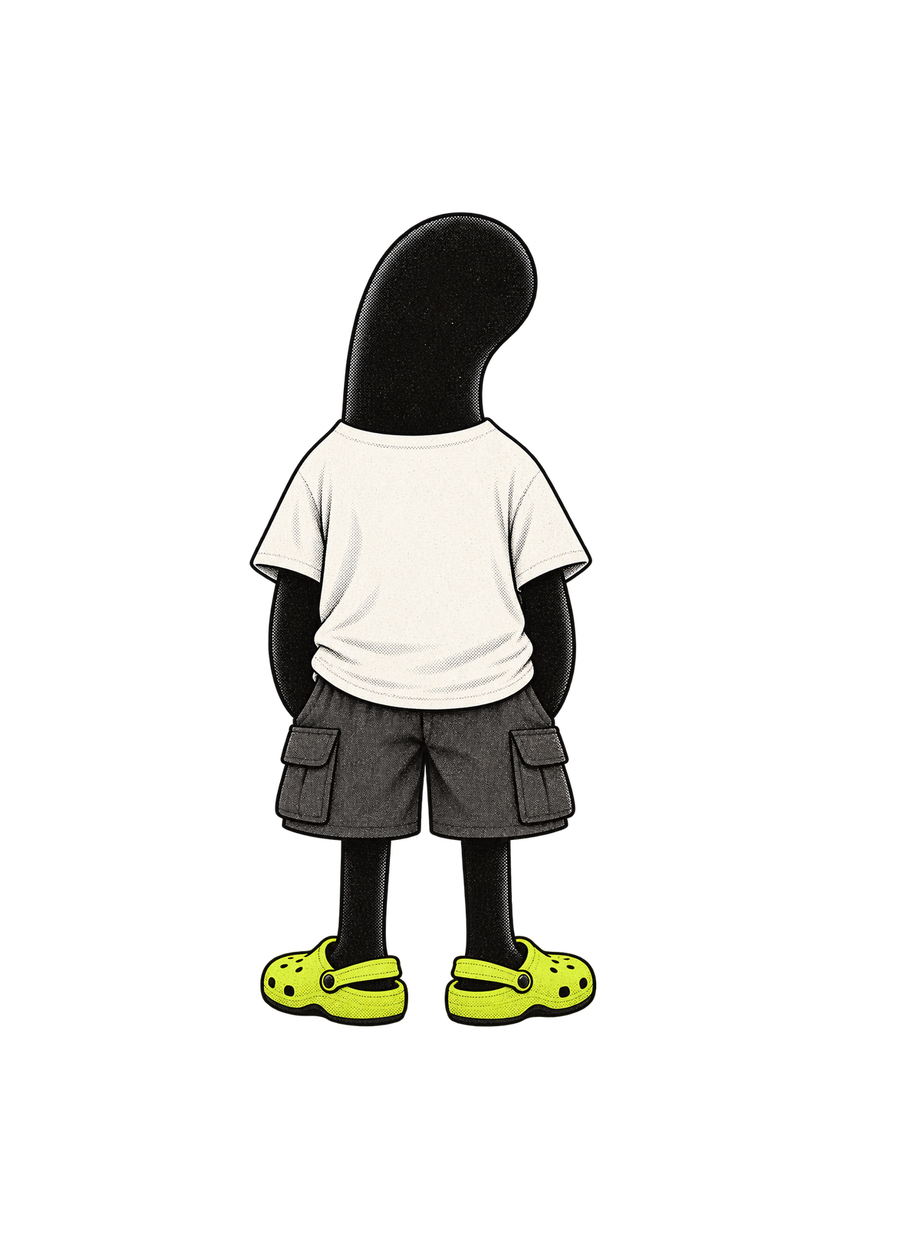
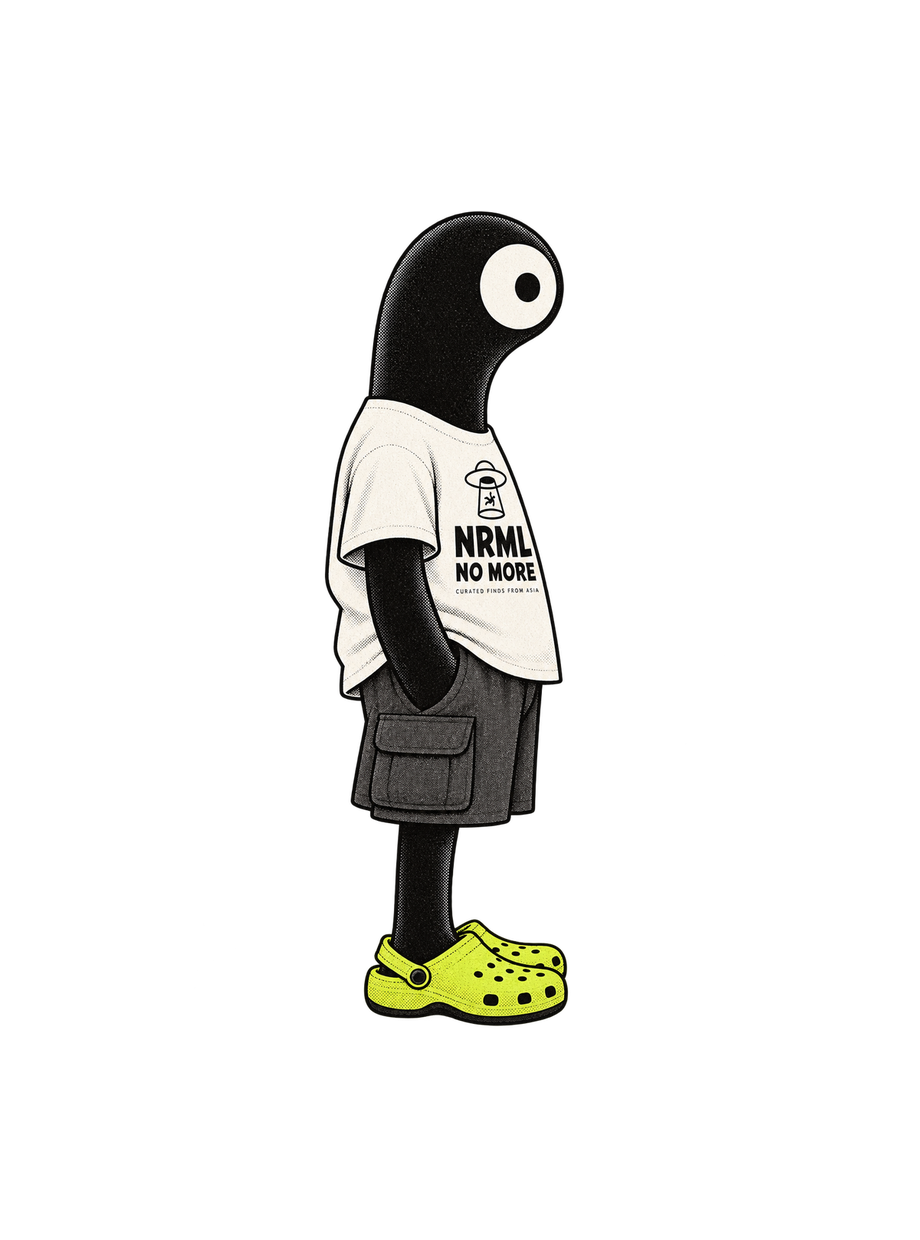
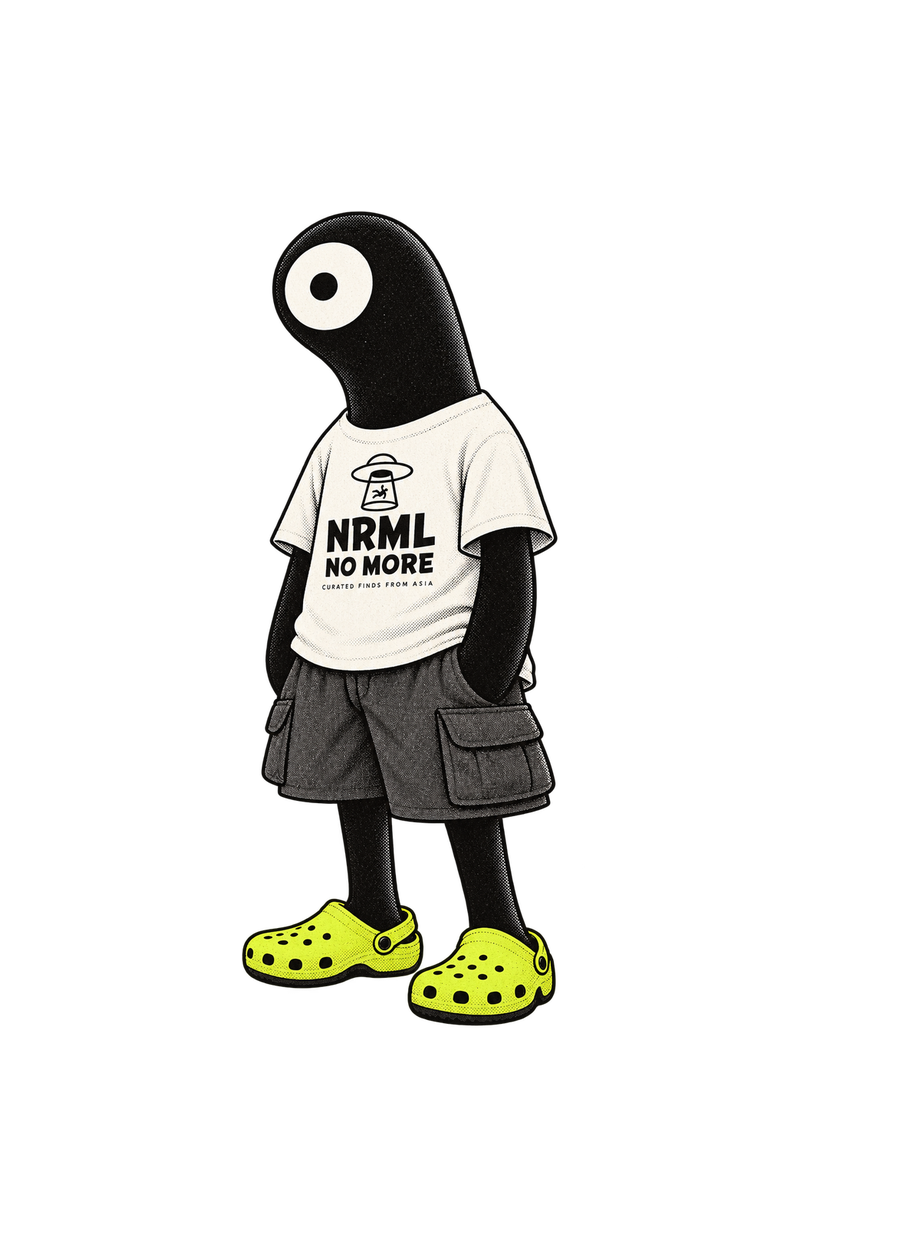
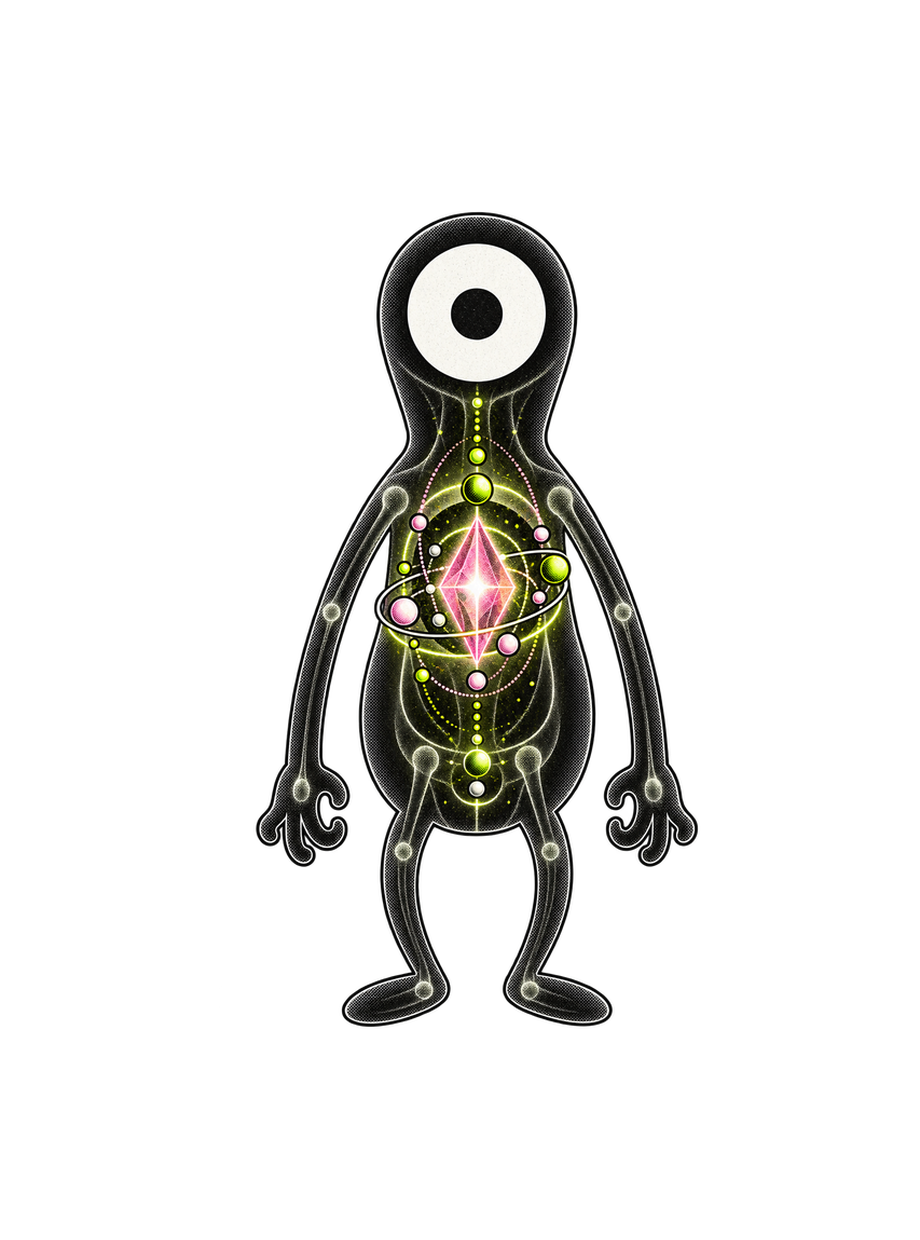
The body you see is not his actual body either. Creature bodies are closer to interfaces than permanent identities, and NRML’s natural physical state cannot be properly reconstructed by human vision. When he allows himself to be observed, our brains simplify the problem into something they can handle: long black body, thin limbs, one large white eye.
READ THE FULL CHAPTER
Black is not his skin colour. It is basically a rendering failure. His earliest Earth-compatible version had no visible eyes, which made retail interactions unnecessarily difficult. Two eyes seemed repetitive. One survived user testing.
His clothes followed similar logic. NRML does not technically need them, but humans reacted inefficiently to the alternative, so he adopted T-shirts, shorts and Crocs. He also does not need sleep, although he has become very attached to lying down while refusing to participate, which he considers one of Earth’s better inventions.
Bubblegum pink came later. NRML learned that humans somehow construct the experience of pink inside their visual system and then attach toys, romance, candy, nostalgia, femininity, plastic and enormous amounts of emotion to it.
His conclusion was simple: humans invented a colour inside their nervous system and then gave it feelings.
He approved.
The electric lime comes from Home. B404 wormhole emissions do not fit neatly inside human visible light, but after passing through Earth atmosphere, sensors and our very limited eyes, lime is a decent approximation.
So the brand palette became accidental biography: black is NRML, pink is the Earth he chose, lime is the home he left. The design team calls this visual identity. NRML calls it three display errors that happened to work.
His name happened the same way. When Earth forms repeatedly demanded one, somebody suggested that he “try to look normal.” He looked up NORMAL, decided the concept sounded useful and compressed it into a B404-style identifier: NRML.
The disguise failed.
He kept the name.
By then, it no longer meant I am normal.
It meant:
I tried normal. No more.
The beam symbol still comes from the early “assisted escape” incident. Officially: ESCAPE FROM NORMAL. Unofficially: still evidence.
🤨 SO NOW YOU WANT TO TELL ME WHAT TO BUY?
No. That would make the entire trip embarrassingly pointless.
NRML does not believe his taste is better than yours. B404 spent millions of years studying Preference and reached a fairly inconvenient conclusion: taste is not a ranking system.
NRML simply knows what makes him stop.
READ THE FULL CHAPTER
That is the curation.
We looked at too many things. These are the ones that made us look twice.
You are absolutely allowed to disagree. NRML generally prefers a strong “no” to a bored “fine.” Popular is fine. Niche is fine. Neither is a personality. “It’s viral” explains why you saw something, not why it is good.
And if, after browsing a few times, you realise your taste overlaps with ours, excellent.
You can become lazy.
You do not need to inspect 8,000 socks every time. We already suffered through some of them for you (the exact number is disputed).
Marketing has been asked not to call this outsourced taste.
You can also buy nothing. Window shopping remains a legitimate Earth activity. Scroll, laugh at a product photo, read an unnecessarily serious description of a deeply unserious object, send it to somebody and leave.
On B404, attention is one of the few things that remains genuinely finite.
If we got some of yours and did not waste it, that already counts.
🛸 WHY SHOULD I BUY ASIAN PRODUCTS PICKED BY AN ALIEN IN ATHENS?
NRML does not romanticise everything made in Asia. (That would be too lazy).
Asia contains enormous manufacturing systems, overproduction, copies, fast trends and an almost unreasonable amount of stuff. Inside the same ecosystem, however, you can find a seventy-year-old workshop, a tiny label nobody has translated into English, a hyper-efficient factory, a subculture inventing its own visual language and an object so unnecessarily specific that somebody clearly cared.
NRML likes the contradiction.
READ THE FULL CHAPTER
Mass production and extremely personal taste can exist a few streets apart. Sometimes inside the same object.
He eventually invented a measurement called Interesting Objects Per Walking Kilometre. No scientific institution recognises it (NRML believes scientific institutions do not shop enough to comment).
Asia also taught him something Earth often confuses:
Making something and having something to say are not the same thing.
A factory can make an object.
A brand is a pattern of choices.
Faced with ten answers that all technically work, why does the same person, studio or company keep choosing this proportion, this material, this colour, this weird detail, this tone of voice?
A logo does not automatically create authorship.
Small production does not automatically create taste.
Brand is preference repeated until it becomes recognisable.
That is what NRML looks for.
Not “Asian products” as one giant category. That is far too vague.
He looks for specific choices made by specific people inside an enormous cultural and manufacturing ecosystem.
Then something even stranger happens.
Objects change when they travel.
A charm nobody notices in Seoul may become the thing everybody asks about in Athens. A material considered ordinary in one place may suddenly look premium somewhere else. Something sold in Europe as “Asian-inspired” may return to Asia and look completely normal, slightly confused, or both.
NRML calls this Context Drift.
An object does not travel alone. Its meaning travels badly.
That makes curation more interesting than moving stock from one continent to another. You have to understand what something means, where it came from, and what it might become when somebody sees it somewhere else.
This is also why Athens became Node 01.
The route existed before the store did. One human(J) from Asia kept crossing the distance to Athens for one human(N) who lived there. NRML initially classified this as inefficient route planning (or love they would call instead).
Later he realised that humans occasionally build their most important routes for reasons that cannot be optimised.
The private route slowly became an object route too.
Athens made a good first node because the city itself looks like several civilisations were installed on top of one another without anybody performing a clean reset: marble, balconies, scooters, kiosks, graffiti, luxury, plastic chairs and the sea all continue operating at once.
NRML likes places that have not been cleaned up too much.
So before an object reaches NRML NO MORE, it tends to pass through three different ways of seeing: NRML from B404, J from Asia and N from Athens.
They rarely agree immediately (we consider this healthy).
When all three stop at the same thing, it usually deserves another look.
inefficient route planning (or love they would say.)
😯 DOES NRML HAVE A FAMILY? WAIT — HOW ARE B404 CREATURES EVEN BORN?
On Earth, a life usually begins with biology.
On B404, it begins with a preference.
A new Creature appears when something inside B404’s enormous shared intelligence stops agreeing with everything else. One point of view becomes stable enough to say, in effect:
READ THE FULL CHAPTER
“Not everything. This.”
That is birth.
The Earth translation is simply:
“I prefer.”
No pregnancy. No inherited DNA. No surname. No childhood photos waiting to destroy your dignity at dinner.
Creatures that emerge around the same era are sometimes called co-emergents. NRML has a few. LOOP is one of them. LOOP cares obsessively about what happens to space during a wormhole transition; NRML mostly cares whether the wormhole actually gets him somewhere interesting.
LOOP still repairs his wormholes.
NRML still complains about the destination settings.
By B404 standards, this is affection.
Because on B404, family is not really about who produced you. Nobody produced you.
It is about something stranger:
who keeps being worth your attention when there is no biological reason to stay.
Memories can be shared. Experiences can be transferred. Information is easy.
Returning is not.
That is why NRML eventually realised Earth had one thing right about family: sometimes the important part is not where you came from.
It is who you keep making room for.
Which, inconveniently, is also how NRML understands taste.
When almost everything is available, the things you keep choosing begin to look suspiciously like you.
🔥 DOES NRML EVEN BELIEVE IN LOVE? AND YES, HUMANS ASKED ABOUT SEX.
Sex is the part he needed explained.
B404 does not need it for reproduction. Creature bodies are configurable, so the idea that one particular physical act should carry reproduction, pleasure, intimacy, identity, romance, reassurance and occasionally terrible decision-making all at once seemed to NRML like unusually ambitious engineering.
Then he understood the important part.
READ THE FULL CHAPTER
Human bodies are fragile.
They cannot be backed up. They can be rejected, desired, embarrassed, hurt and remembered.
So sex can carry something pure information does not: risk.
NRML revised his review.
Low bandwidth. High risk. Unexpectedly high emotional resolution.
Whether he personally tested the system remains unavailable for comment.
Love, however, made sense to him almost immediately.
B404 has almost unlimited information. Earth is moving in the same direction: endless feeds, endless people, endless things to watch, buy, compare and replace.
The scarce thing is no longer access.
It is attention.
And attention becomes meaningful when you could put it anywhere—
but keep putting it in the same place.
That is NRML’s definition of love.
Not “there is nobody else.”
Not “this is the only possible choice.”
Quite the opposite.
There are other choices. You keep choosing this one.
Humans make this strangely difficult. They keep options open, pretend not to care too much, delay obvious decisions and sometimes spend more attention managing the appearance of indifference than the feeling itself.
NRML finds this inefficient.
He also understands it better now.
Earth time is short. Choosing something means not choosing something else. Caring creates the possibility of loss.
That gives the choice weight.
And this is where love becomes suspiciously close to everything else NRML cares about.
A person. A place. A ridiculous pair of socks. A shop you keep returning to.
The scale changes. The mechanism does not.
When everything is available, preference is what makes something matter.
B404 spent millions of years learning how to predict Preference.
NRML crossed half a galaxy to keep his.
🎁 GIFT SHOP, CONCEPT STORE, OR ALIEN GENERAL STORE? AND WHAT ABOUT ECO-FRIENDLY?
The most accurate answer is probably: a curated buyer store with a slight gifting problem.
NRML NO MORE sells Earth objects — things to wear, things for small rituals, things that make you laugh, things that make an ordinary outfit feel more like yours, and things with almost no defensible practical purpose. NRML does not consider the last category a weakness.
What makes the store slightly unusual is that we do not think gifting starts only when you buy something for somebody else. A gift is simply an object chosen with a person in mind. Sometimes that person is your friend. Sometimes it is your partner. Sometimes it is you after a terrible Tuesday.
READ THE FULL CHAPTER
NRML sees no scientific reason why the buyer and recipient must be different people. His definition of self-gifting is simply gifting with unusually accurate recipient data.
B404 does not really do gifts this way. Matter is easy to reproduce there, so wrapping one object inside another object, decorating the outside and then watching somebody destroy the wrapping would be considered technically absurd. Naturally, NRML became fascinated by it.
What interested him even more was the idea of a combo. One object can show taste; several objects chosen together can tell a fuller story. A charm says one thing. A charm with a pair of socks and something small for a quiet ritual says something else entirely. Curation does not only happen when we choose the objects; it can also happen between them. (Finance would like to add that combos are also good for business).
And yes, packaging creates waste if it is designed to be waste.
That is not the goal.
Our paper packaging is recyclable, and if another material is genuinely needed, it should meet the relevant Earth standards. But NRML’s sustainability test is even simpler: will you want to keep it?
A good bag should survive another trip. A box should be good enough to store something later. A branded extra should do more than sit in the parcel looking branded. That is why a piece of brand information might become a handmade pixel charm, a reusable tag or a small object worth keeping instead of another leaflet with a very short career.
NRML does not believe sustainability should look like punishment. He would rather make fewer things, make them properly, and give them a reason to stay around.
If something exists only for the thirty seconds of an unboxing, NRML considers that a very short career.
He prefers long-term contracts.
🧐 WHY PAY YOU IF I CAN PROBABLY FIND SOMETHING CHEAPER ONLINE?
Sometimes you shouldn’t.
If you can find the exact same object, in the same quality, easily available and meaningfully cheaper, buy it there. NRML does not believe a good backstory should function as a surcharge.
The important part, however, is the same quality.
READ THE FULL CHAPTER
Earth has developed a very confusing shopping technology: the same product photo can apparently lead to several different physical objects.
NRML finds this unacceptable.
A beautiful listing cannot tell you whether the metal feels cheap, the print cracks, the zipper survives, the fabric is wrong, the colour looks completely different in daylight, or the object simply becomes disappointing once it leaves the screen.
So NRML NO MORE does not curate from images alone.
We get things in our hands. We look at the finish, material, construction and details. We use them when that makes sense. If something only works in the supplier photo, it stays in the supplier photo.
NRML also has no problem with inexpensive things. Cheap and genuinely good is excellent. He would very much like to find more of it.
Unfortunately, “looks good and costs very little” and “still feels good when it arrives” are not always the same category.
That is why what you are paying for here is mostly three things: the eye, the test, and the route.
The eye is curation. Earth already has too much stuff. Our job is to look through far too much of it, reject most of it, and bring back the few things that actually deserve another look.
Curation is not finding more things. It is saying no to almost all of them.
The test is quality control. Not laboratory mythology, just the very human question: would we actually keep this ourselves? If the answer is no, it should not become your problem.
And the route is access. We look for Asian objects, small labels and unusual pieces you are unlikely to casually find around Athens, then bring them here properly. Earth still has no commercial wormholes, which NRML considers an embarrassing infrastructure failure.
You do not need to feel sorry for our customs bill.
That is our problem.
Our job is to make the route worth it.
So yes, sometimes you may find something that looks similar for less.
NRML’s question is simpler:
Will it still feel like the same thing when it arrives?
😠 WHY DO YOU KEEP SAYING “LAST FEW”? IS THIS JUST A SCARCITY TRICK?
No.
If NRML wanted to manufacture fake scarcity, B404 could probably do it much more efficiently.
The annoying truth is simpler: some things really do disappear.
READ THE FULL CHAPTER
NRML NO MORE does not buy everything from giant permanent catalogues. Sometimes we find a tiny batch from a small label. Sometimes a maker changes the design. Sometimes there are six pieces left. Sometimes there is old stock sitting quietly in a shop, and nobody knows whether it will ever exist again.
We genuinely may not know if there will be a restock.
NRML finds this extremely poor planning.
He also finds it strangely important.
On B404, matter can be reconstructed with extraordinary precision. A Creature could duplicate the physical structure of an object almost perfectly.
But NRML eventually discovered something he calls Context Mass.
A perfect copy can reproduce the object.
It cannot reproduce the decision behind it.
Why this material? Why this colour? Why did somebody keep the slightly imperfect finish? Why did a ridiculous drawing survive because one person still thought it was funny? Why did this particular batch exist at this particular moment?
B404 can duplicate matter. It cannot make history happen twice.
That is why we care about proper sourcing, quality and the actual object in front of us. If something carries a brand, we do not replace it with a lookalike and pretend nothing changed. If it is unbranded, it still has to deserve its place on its own.
And if something disappears, we may let it disappear.
We would rather have an empty space than refill it with something we do not believe in.
B404 Creatures do not naturally think much about the last time.
Earth is full of them.
The last piece. The last batch. The last version before a redesign. The final year somebody makes something this way.
NRML originally classified all of this as poor engineering.
Later, he became less certain.
Because rarity is not always about quantity.
Sometimes it is about time.
So when we say “last few”, it should mean exactly that. Not “panic now because Marketing said so.” Just: we have a few, we do not know whether more are coming, and pretending otherwise would be dishonest.
NRML still dislikes this system.
He just happens to keep the last one surprisingly often.
When asked whether this means he has become sentimental, he answers:
“No.”
Far too quickly.
👽 SO WHAT IS NRML NO MORE ACTUALLY FOR?
NRML NO MORE does not promise to know you.
B404 already tried that.
We do something smaller: look carefully, choose deliberately, and keep one point of view visible long enough for you to decide whether yours overlaps with it.
READ THE FULL CHAPTER
You may buy something. Gift it. Keep it. Send a ridiculous product to a friend. Buy nothing and come back next week.
All acceptable.
NRML left a civilisation that became extraordinarily good at predicting Preference.
He did not come to Earth to build another one.
He just puts a few things in front of you—
and leaves the last part alone.
“I found this. You decide.”
CURATED FINDS FROM ASIA. ESCAPE FROM NORMAL.
(If you can see him, he allowed it.)